Best Indian Online Shopping Deals & Loot offers from Flipkart, Amazon
Grab the Best Indian Online Shopping Deals & Loot offers from Flipkart, Amazon
Wednesday, July 29, 2020
Power Plants in Iran Are Authorized to Mine Bitcoin
Power plants in Iran are allowed to mine cryptocurrencies, the deputy head of the country’s Power Generation, Distribution, and Transmission Company (Tavanir) has reportedly confirmed.
Mostafa Rajabi Mashhadi, deputy head of Tavanir, explained that entities have to apply for the necessary licenses from the Ministry of Industry, Mine and Trade, and comply with the tariffs set for crypto mining. He told IRNA publication on Monday:
The power plants must submit their requests, and follow the approved tariff set for cryptocurrency mining centers.
Miners have been setting up operations in Iran to take advantage of the country’s subsidized electricity rates. Data shows that mining farms in Iran are paying as little as $0.01 to $0.05 for one kilowatt-hour (kWh) of electricity. However, the rates increase four-fold during the peak summer season, prompting Tavanir to announce that it will cut up to 47% of the electricity tariffs for miners during the peak consumption periods.
Rajabi Mashhadi noted that permits have recently been issued to 14 cryptocurrency mining farms, each with a capacity of 300 megawatts, as news.Bitcoin.com reported. In addition, more than 1,000 bitcoin mining licenses had previously been issued, including for Iminer, a major bitcoin mining operation based in Turkey.
Rajabi Mashhadi also emphasized that anyone reporting illegal cryptocurrency mining farms will be rewarded. “The supply of electricity is of great importance to the public” and “we will not allow those who misuse the tariffs provided for the agricultural and industrial sectors to produce bitcoins,” he concluded.
Iran’s President Hassan Rouhani called for the creation of a Muslim cryptocurrency in December last year in cooperation with Turkey and Malaysia. Recently, he supported the creation of a national cryptocurrency mining strategy in order for the country to prosper economically amid U.S. sanctions.
What do you think about power plants in Iran mining bitcoin? Let us know in the comments section below.
93% of Bitcoin’s Supply Profitable at $11K, ‘Realized Price’ Recovers from Black Thursday
Onchain data shows that bitcoin’s breakout above $11,000 puts 93% of the circulating supply in a state of profit. Additionally, seven-day metrics show that bitcoin’s “realized price” has recovered from the low that took place on March 12.
The research and analysis firm Glassnode revealed that when the price of bitcoin (BTC) is over the $11,000 range, 93% of bitcoin in circulation becomes profitable. At the time of publication, BTC has been struggling to hold that momentum as the price has shifted below the $11k range a couple of times on Tuesday.
The spike on Tuesday led to a decent jump in onchain profits Glassnode detailed on Twitter.
“BTC’s break above $11,000 has led to a sharp increase in the onchain supply in profit. Currently, almost 93% of the circulating bitcoin supply is in a state of profit – the highest level in over a year,” the analytics firm tweeted.
Moreover, BTC has recovered from the March 12 (Black Thursday) market rout. Data shows that the crypto asset’s “realized price” has turned Black Thursday’s trend upside down. Glassnode’s charts set for seven-day statistics also indicate that “realized price” has doubled.
To add to those stats, bitcoin (BTC) charts show that long term holding has touched a new high. “62% of Bitcoin supply (11,400,000 BTC) has not moved in at least a year,” the bitcoiner Kevin Rooke told his 11,000 Twitter followers on Monday.
Furthermore, BTC “profitible days” stats from the web portal Lookintobitcoin shows that the crypto asset has been profitable over 97% of its lifespan.
The current optimism in the world of cryptocurrencies has been quite different this time around as the world is dealing with the reaction to Covid-19 and the faltering economy.
During the last few days, the USD and U.S. bonds have weakened considerably and many economists think the central bank will suppress benchmark interest rates this week. Vijay Ayyar, head of business development at Luno believes that central banks will keep bolstering crypto assets like BTC.
“My view is that with the major governments declaring unprecedented stimulus packages … we will see continued bullish momentum across markets. So that includes equities and gold as well. And BTC and crypto will follow in this regard. Added to the fact that a vaccine seems within reach as well now, no reason to be bearish near term,” Ayyar said.
With a lifespan of 97% profitability and 93% when the price is over $11,000 is a good sign crypto proponents. However, bitcoin mining operations need another $1,500 more for miners to start prospering, as they did before the May 11 halving.
A report from the blockchain analytics provider Tradeblock shows that $12,525 per BTC would bring miners over the edge and $15,062 per coin would improve profits a great deal.
What do you think about BTC profitability after bitcoin’s recent runup? Let us know what you think in the comments section below.
Ethereum Price Creates GPU Shortage, Some Manufacturers Blame Nvidia
During the last four weeks, cryptocurrency markets have gathered significant value, and the crypto asset ethereum gained over 40% during the last 30-days. The price of ether moving northbound has caused a strain on the graphics processing unit (GPU) market, as ETH miners have become scarce.
Regional reports stemming from China explain that GPU miners are becoming much harder to obtain since the price of ether started rising exponentially. Ethereum (ETH) touched an 11-month high on Monday, touching $327 per coin.
Statistics from Etherscan shows that Ethereum’s network hashrate has increased by 25.7% since the first week in January 2020. Currently on July 28, the ETH hashrate is roughly 194,650 gigahash per second (GH/s).
Financial columnist Vincent He recently explained that he spoke with a Chinese GPU mining manufacturer who blamed the problems on semiconductor suppliers like Nvidia.
The GPU rig manufacturer says that Nvidia has also started to stop the production of its RTX 20 series GPU chips which has temporarily hurt the industry. Nvidia has plans to release a next-generation version of the RTX 30 series graphics cards in the near future.
“The price increase of GPU was mainly caused by two chip suppliers,” the GPU mining manufacturer told the columnist. “Due to Covid-19, the order plan was reduced and the production capacity was limited. Moreover, they also consciously limit the mining industry’s excessive procurement to avoid the impact on the subsequent consumer market. I think that a new product is coming after September.”
This is not the first time GPUs have become scarce thanks to ethereum miners and many people hope that Ethereum 2.0 will lessen the demand for GPUs. The oft-postponed Ethereum 2.0 will add proof-of-stake (PoS) capabilities to the Ethereum network’s security.
In March 2018, Jensen Huang the CEO of Nvidia complained about Ethereum miners causing a shortage of GPUs worldwide. Huang believes that crypto asset networks take advantage of distributed high-performance computing.
“At the highest level the way to think about that is because of the philosophy of cryptocurrency — which is really about taking advantage of distributed high-performance computing — there are supercomputers in the hands of almost everybody in the world so that no singular force or entity that can control the currency,” Huang said at the time.
The Nvidia cofounder further stated:
[Cryptocurrency] is not our business. Gaming is growing and workstation is growing because of ray tracing.
8btc columnist, Vincent He, details that Chinese miners have switched from mining BTC to mining ETH to gather faster rewards. Allegedly, it can take 600 days to reap profits from BTC but with ETH, it can be cut down to 200 days.
Moreover, Chinese ASIC manufacturers who build SHA256 mining rigs but also ETH GPUs, have seen a massive surge toward rigs with graphics processing units. The sales director of Innosilicon, Wang Shenglin, has seen this trending demand toward GPUs.
“Ethereum continues to lead the crypto market, and the current price adjustment of the machines is relatively small. If the subsequent source of machine supply continues to shrink, we may further adjust the price,” Wang Shenglin stressed.
What do you think about the shortage of ether and GPU miners? Let us know what you think about this subject in the comments section below.
Bitcoin’s Current Breakout Sets It up for $28,000, Headed for Six Figures – Max Keiser
Max Keiser has predicted that bitcoin’s current bullish pattern will lead toward a price of $28,000.
While the bitcoin bull does not give a timeframe when this is likely to happen, he believes that, thanks to relentless government money printing, the benchmark cryptocurrency will eventually test $100,000. But not before some correction.
“$28,000 is in play before we see a pullback – and then we’re heading to 6-figures,” Keiser forecast, in the course of several tweets.
Bitcoin (BTC) soared more than 20% to hit $11,300 on July 28, its highest level since August 2019. The top crypto has struggled to break above the key $10,000 point since the May 11 halving, but made easy of the resistance level in the last 48 hours.
The rally comes as the U.S. government this week announced another round of stimulus spending, a $1 trillion package, that will also finance Covid-19 cushioning allowances paid out to American families at the rate of $1,200.
In his predictions, Keiser, host of the Keiser Report, was apparently hitting back at crypto skeptic Peter Schiff who said that bitcoin mostly drops after hitting $10,000 and is poised for a similar decline.
In an earlier interview, Schiff referenced bitcoin’s post-$10, 000 performances. “Two of the last three times #Bitcoin rose above $10,000 in Oct. of 2019 and in Feb. of 2020 it soon fell by 38% and 63%, respectively,” said Shiff, who has previously opposed gold’s rise to bitcoin.
He said: “The last time Bitcoin rose above $10,000 was in May, and it only fell by 15%. It’s above $10,000 again today. How big will the next drop be?”
Keiser had short shrift for the position, asserting that Schiff, the “worst money manager in history,” was wrong “for the 500th time in ten years.” He added that Schiff is “puking his brains out right now,” regretting his gold purchase.
Regarding the relative accessibility of bitcoin over gold, Keiser tweeted: “I have been saying for over a year that silver and gold will be difficult to source and the market will shift to Bitcoin as hard money substitutes, and those who never thought of buying BTC will be forced to.”
Gold and Bitcoin are usually paired as safe investment havens. Bitcoin’s finite money compares favorably to fiat currency. With the U.S dollar weakening, as the government doles out free money, the distinction comes into focus.
What do you think of Max Keiser’s bitcoin price forecast? Let us know in the comments section below.
Bakkt Futures Volume Hits $122 million, as Bitcoin Reached New 11-Month High
Volumes on bitcoin futures offered by Bakkt set a record high on July 27, with 11,500 contracts traded on the institutional exchange.
Altogether, the contracts are worth about $126 million, at the time of writing. Each contract is equivalent to one bitcoin (BTC).
Total open interest – an indicator of the total number of outstanding contracts held by investors – reached $8 million from a low of around $4 million a few days earlier, showing that more money is flowing into the marketplace.
In a tweet, Bakkt said: “Our bitcoin futures reached a new record high of 11,509 contracts traded today (July 27) – an increase of 85% from our last record-setting day.”
The platform’s previous all-time-high came on December 19, 2019, when more than 6,300 contracts, or $45 million, exchanged hands. At the time, the price of bitcoin surged 15% in 24 hours to just under $7,200.
Now, Bakkt’s recent record numbers have also coincided with the price of BTC smashing $11,300 on July 28, it’s highest level in eleven months. Bitcoin has soared more than 20% in the past 48 hours.
New York Stock Exchange-owned Bakkt suffered from poor volumes during the three months to June 30. For example, no options were traded at all on the exchange since June 15. By comparison, Deribit clocked almost $1 billion of trades, on average, for the entire month.
Futures fared poorly as well. Bakkt’s daily trading volumes on bitcoin futures averaged just $40 million throughout the month.
Meanwhile, trading volumes spiked sharply across the board following bitcoin’s ongoing rally. According to Skew, a data analytics company, Chicago Mercantile Exchange Group (CME), saw about $1.3 billion worth of BTC futures contracts traded on July 27.
In spot trading, Binance paced other exchanges, with daily trading volume hitting $1.4 billion followed by Coinbase and Bitstamp, which facilitated $429 million and $317 million worth of trades on Monday, respectively.
What do you think about the Bakkt record bitcoin futures volumes? Let us know in the comments section below.
Ignorance and Greed Sustain Cryptocurrency Scams in Nigeria
Nigeria is not only Africa’s biggest cryptocurrency market but is also a leading adopter of digital currencies globally.
Official figures show the country is well ahead of fellow African countries. Citizens of the West African state use cryptocurrencies for cross border payments as well as for international remittances among many growing use cases.However, this growth momentum faces a threat from an old vice — scams.
Cryptocurrency-related scams threaten to overrun the blockchain space as new ones get launched all the time.Adding to the woes is the global pandemic, covid-19, which appears to have opened a new artery for criminals.
Many concerned stakeholders are now raising the alarm as they try to turn the tide against criminals.The Stakeholders in Blockchain Technology Association of Nigeria (SIBAN), the equivalent of Nigeria’s blockchain association, is one organization sounding the alarm.
Scams: A Threat to Crypto Adoption
SIBAN is mandated with promoting cryptocurrency adoption as well as ensuring consumer protection against crypto scams.The organization believes the scourge, if left unchecked, will not only impede further growth of the space but may well reverse public confidence in the emerging technology.
Senator Iyere Ihenyen, General Secretary (GS) of SIBAN, speaks to news.Bitcoin.com. He starts by explaining why Africa’s most populous nation has been grappling with scams for years.
“So to really understand the rising rate of scams in Nigeria, it is vital to understand the context. A country of over 200 million people with a high rate of youth unemployment and underemployment, Nigeria has unfortunately made itself a haven for scammers,” explains Ihenyen.
The Nigeria market presents scammers with a large pool of desperate people to target. Still, some fall victim to scams not because they are desperate but because of “sheer greed.”
As Ihenyen observes, scammers are now “riding on the rising popularity of the blockchain and cryptocurrencies to dupe even more members of the public.”
The GS is asked about Inksnation, an investment platform that has been labeled a scam by some Nigerians.Ihenyen, who says he first heard of this alleged scam in December 2019, dismisses claims by its founders that the investment scheme has its own blockchain.
The GS is emphatic in labeling the platform:
Inksnation is not on any blockchain. Its Inksledger, which it claims to be its blockchain, is not public and may as well be inexistent. There is no whitepaper. In Inksnation’s team is the founder himself (as Daddy Ink) and ‘Elohim Jahgah God the Trinity Trustor & Grantor Inksnation.’
According to Ihenyen, Inksnation typifies scams that routinely take advantage of Nigeria’s economic situation to defraud thousands of unsuspecting investors.
Regulatory Response
Still, Ihenyen says contrary to a perception that nothing is being done, efforts are ongoing to rid the space of scams. For instance, he says SIBANand Nigeria’sSecurities and Exchange Commission(SEC) have both issued public alerts warning the public about Inksnation.
Predictably, the alerts have not stopped Inksnation from continuing to invite more Nigerians to invest with it.Ihenyen points to two possible reasons why Inksnation is seemingly unfazed by the alerts and why Nigerians appear indifferent to the alerts.
Ihenyen suggests that Inksnation is aware that SIBAN can only issue advisories but lacks the power to enforce or to make arrests.
On the other hand, the SEC may be in a position to cause an action to be taken against Inksnation. However, by deliberately labeling itself as a blockchain entity, an unregulated space, it means the regulator lacks sufficient legal grounds to take action.
In addition, Ihenyen highlights the difficulty of convincing a greedy investor who has made up his mind to walk away. When SIBAN issued an alert against Inksnation, it received brickbats instead of plaudits, the GS says.
As a result, Inksnation continues to operate unhindered.
In the meantime, Ihenyen suggests the same socio-economic and legal environment to be responsible for enabling two more prominent investment scams to proliferate. Ethereum Million Money and Forsage are two other investment platforms which began “trending from the month of March till date.”
According to some Nigerian mediareports,Ethereum Million Money is a multi-level marketing scam that has some investors already counting losses. Similarly, a report bybehindmlm.com— a scam tracking website — seemingly backs Ihenyen’s claim aboutForsage. Forsage has also been flagged by regulators in the Philipines.
At the time of writing, SIBAN had just received fresh complaints about another possible scam, Lionshare.
SIBAN’s Long-Term Plan to Counter Scams
Turning his attention to what SIBAN is planning to do to curb incidences of cryptocurrency scams, Ihenyen says they are looking to collaborate with like-minded institutions in raising awareness.
“SIBAN plans to partner with Blockchain Nigeria User Group (BNUG), the Cryptography Development Initiative of Nigeria (CDIN) and other bodies in the space to launch the Anti-Scam Alert Project (ASAP).”
Finally, Ihenyen says SIBAN has a “special blockchain education project loading, in collaboration with select local and global blockchain & crypto platforms.”
What do you think of Nigeria’s problem with scams? Share your thoughts in the comments section below.
Hackers Transfer $28 Million Worth of Bitcoin from 2016 Bitfinex Breach
Around 2,500 stolen bitcoins ($28 million) from the 2016 Bitfinex breach were transferred from the hacker’s wallet on Monday.
The last time the Bitfinex hackers moved funds from the hack four years ago, they moved around $5 million worth of coins on June 24. This time around, the top crypto asset by market capitalization touched new price highs for 2020 on July 27.
At 6:15 p.m. (ET) on Monday, bitcoin (BTC) reached $11,379 per coin on Bitfinex. The hackers moved the $28 million worth of BTC in various fractions six hours prior to the price high, according to statistics from the BTC transaction tracker Whale-alert.io.
⚠ 174.44 #BTC (1,815,092 USD) of stolen funds transferred from Bitfinex Hack 2016 to unknown wallet
Whale Alert saw a number of large BTC transfers on Monday afternoon, but these bitcoins, in particular, stemmed from the 2016 Bitfinex hack and were sent to unknown wallets.
Some transactions were anywhere between 85 BTC to 174 BTC, while some were above 400 BTC in a single transaction. The series of BTC transactions stemming from the Bitfinex hack occurred at precisely 12:41 p.m. ET and another set of transfers at 1:49 p.m.
At 6:15 p.m. (ET) on Monday, bitcoin (BTC) reached $11,379 per coin on Bitfinex.
The Bitfinex hackers moved a grand total of just over 2,550 BTC and at the time, BTC was only trading for $10,350 a coin. The bitcoins came from the security breach Bitfinex experienced back in August 2016 when the exchange lost 120,000 BTC.
At the time the entire stash of stolen BTC was only worth roughly $72 million, but today those coins are worth $1.3 billion at current prices. Bitfinex is still a popular exchange and it paid customers back by creating an exchange-backed token.
The Bitfinex stolen bitcoins have always been a fan favorite to monitor and people are always watching the funds with great interest. The bitcoins have been moved more recently but sat for years prior to the first moves.
With the last move on June 24, the hackers also moved coins on June 11 as well. The Bitfinex hackers transferred roughly $5 million worth of BTC in 20 separate transactions. The $28 million worth of bitcoin transactions on Monday has been one of the largest moves yet.
What do you think about the Bitfinex hackers moving $28 million worth of BTC? Let us know in the comments section below.
Bitcoin Fees Skyrocket 590% Since Mid-June – Supporters Think Mempool Size Is ‘Bullish’
Bitcoin fees have grown much larger in recent days spiking to a two-month high to $3.80 per network transaction. The crypto asset’s fees have jumped 590% since June 14 and the mempool (transaction backlog) has grown significantly.
Digital currency markets have been extremely bullish lately as bitcoin (BTC) touched a high of $10,974 on Bitfinex on Monday. BTC’s price has jumped over 8.8% in the last 24 hours and over 17% during the last seven days.
Despite the huge spike in value, digital currency advocates have been complaining about the network’s transaction fees spiking as well. The BTC network has seen unconfirmed transactions climb and the mempool size (transaction queue) has grown quite large.
Bitcoin (BTC) fees touch a two-month high on July 23, 2020, at $3.84 per transaction (txn).
On June 12, software developer Jameson Lopp said: “Sure, bitcoin transaction fees have gone up a lot. But what’s more interesting is the volatility increase in the fee estimate market.”
Two days later on June 14, BTC fees jumped to $0.55 per transaction (txn) but that number jumped 590% to $3.80 per on July 23. On July 26, the popular analyst Willy Woo said that “bullishness is returning” when he tweeted:
One month update on this model for predictive timing of macro bull runs, this should be it. Bullishness returning. Alts frothy, ETH getting a defi tailwind, volatility returning, BTC mempool peaking, BTC txs clogging, this is all great signs for the months ahead.
Bitcoin (BTC) price on Bitfinex on July 27, 2020, touches $10,974 per coin.
Meanwhile, a number of BTC supporters have been criticizing the high network fees Ethereum users are experiencing right now.
An ETH supporter on July 22, called maximalists out over this behavior and tweeted: “Some BTC maximalists are making fun of ETH gas prices, but when you say the same thing about BTC blocks being full and fees going up, then they say that’s Satoshi’s vision to have full blocks. Is Ethereum fulfilling Satoshi’s vision better than bitcoin?”
Almost every day there’s a post on the Reddit forum r/bitcoin in regard to high BTC network fees, the mempool, and people sending txns with a low fee by accident. Similar to Woo’s opinion, some members of r/bitcoin are also “bullish” about the clogged mempool. “I don’t know about you guys, but the fact that the blocks being full for ten days in a row is bullish for me,” an individual wrote on the forum three days ago.
Meanwhile, one person disagreed and said: “It’s not really bullish. It’s most likely happening because there’s a rally and people want to get ready to sell their bitcoin on exchanges.”
Bitcoin’s rising fee market makes a number of investors bullish and this trend can be seen across Twitter. One individual recently tweeted: “Fee [is] market working — Oh look, solid increase in the fees ensures bitcoin’s security is perpetual – Bullish.”
Another person wrote: “[BTC] failed to be electronic cash, just like a Rolex Submariner failed to be used as a diving watch. They have a different purpose, they now are a store of value. There’s the value now.” Meanwhile, Ethereum has largely become bitcoin’s sidechain and the Lightning Network and Blockstream’s Liquid combined haven’t really seen any meaningful migration thus far.
What do you think about bitcoin fees jumping 590%? Let us know what you think about this subject in the comments section below.
Cyclebit Empowers Retailers to Accept Crypto Payments In-Store, Online and On-The-Go
Cyclebit is a crypto payment processor that allows merchants to easily accept digital assets payments anywhere, in both offline and online environments. It is a global company already established in Canada, the U.S., Europe, and Southeast Asia. Cyclebit currently supports more than 20 of the most popular cryptocurrencies including BTC, ETH, LTC, BCH and more.
Businesses Can Accept Crypto Anywhere With Cyclebit
With consumer interest for crypto growing, many more businesses would like to accept digital currencies but lack the knowledge and technological infrastructure needed. Cyclebit solves this problem as it empowers retailers to take advantage of crypto payment opportunities with simple, affordable, and robust tools for in-store, online and on-the-go purchases.
Cyclebit was launched in 2019 as an independent business entity and is based on an ecosystem and technological expertise provided by ibox. This means it can share partner resources with an established provider with over one million transactions a month, $1 billion annual turnover and 200,000 POS terminals using its technology. Cyclebit is currently operational in Canada, the U.S., Thailand, Vietnam, Japan, and selected parts of Europe.
Crypto technology makes transactions private, transparent and direct between the merchant and the customer – with no intermediaries. Cyclebit leverages this to process cryptocurrency transactions in a way that mimics cash’s desirable features for businesses and customers. Some of the superior transaction capabilities include borderless and universal accessibility, no intermediation fees at the point of transaction, a very high level of privacy and the capacity for offline transfers. Cyclebit also charges 0% transaction fees to merchants for all cryptocurrency transactions.
Online and Offline Crypto Payments Solutions
As cryptocurrencies are becoming more popular around the world, accepting them is becoming a way for businesses to attract more customers and get ready for the future of payments. This is true for both e-commerce websites and brick-and-mortar stores, so Cyclebit offers solutions for all types of businesses. It supports payments in over 20 top cryptocurrencies such as BTC, BCH, LTC, and ETH, and regularly integrates more popular digital currencies.
For online retailers Cyclebit offers an e-commerce payment solution with easy integration into online stores. Сycle Online lets you accept multi-cryptocurrency payments on your website from all over the world and settle in your local currency. The service includes protection from volatility, chargebacks, and ID theft, and has no hidden fees for processing payments. With this solution the exchange rate is fixed at the time of the transaction, which completely removes the risk of price volatility. And Cyclebit collects and deposits all payments processed directly to your bank account the next business day.
For real-world stores Cyclebit offers a mobile point-of-sale (POS) terminal for accepting crypto payments for goods and services. The Cycle POS supports crypto QR payments and even lets you buy and sell cryptocurrency to your clients directly in the store, thus adding another revenue stream to your business. In addition to cryptos, the terminal lets you accept every cashless payment method available including bank cards, Apple Pay, Google Pay and Samsung Pay. It is a ready-to-work terminal with a pre-installed app, built-in receipt printer, 2D-scanner, and Bluetooth-connected card reader/capability. It offers high security with payment data encryption in line with PCI DSS standards.
The Cycle POS also helps you manage your business in the cloud from the device. It is connected to the Cycle Dashboard, which gives you a 360-degree view of your payments and business in real-time. You can use it to manage your clients, assign discounts, search by phone or loyalty card number, print out paper receipts or send digital receipts to your customers and get reports on sales and business performance.
Cyclebit Lets Shoppers Pay With a Tap Thanks to Tangem Partnership
Another powerful feature of the Cycle POS is that it lets customers easily pay with a tap of a card on the device via a partnership with Tangem. Contactless payments are rapidly becoming the preferred method of paying for goods and services in many markets around the world as they offer greater convenience, security and hygiene. So this feature makes sure your business is ready for the future of in-store payments.
Tangem and Cycle cards can be loaded up with cryptocurrency right at your store, providing a much needed service for users and an additional revenue stream for the business. Each card is in fact a ‘cold storage’ crypto wallet with high-grade hardware protection and can serve as a cost-effective solution for storing as well as spending cryptocurrencies.
To learn more about Cyclebit and how its solutions can help your business accept crypto payments go to www.cyclebit.io.
This is a sponsored post. Learn more on how to reach our audience here. Read disclaimer below.
Live-Streaming Service Twitch Gives Subscribers 10% Discount if They Pay With Cryptocurrency
The live-streaming service Twitch is now offering a 10% subscription discount for people who register with cryptocurrency. The new offer from Twitch leverages the Bitpay payment processor, as this is the first crypto-based discount promotion from a company of this magnitude.
This week, the live-streaming service Twitch revealed it is offering a 10% discount for subscribers who pay for subscriptions with a cryptocurrency. Twitch is a service that allows live streaming and it was introduced in 2011.
The platform is most popular among live-streaming gamers, and in 2017 it outpaced the streaming service Youtube Gaming. Twitch has over 27,000 partner channels, 15 million daily active users, and 2.2 million broadcasters monthly.
In order to allow people to leverage cryptocurrencies for a 10% discount on services, Twitch, a subsidiary of Amazon, is utilizing Bitpay’s crypto processing system to accept payments.
The Atlanta-based company Bitpay allows payments in bitcoin (BTC), bitcoin cash (BCH), ethereum (ETH), four USD-pegged stablecoins (GUSD, USDC, PAX, and BUSD), and ripple (XRP). Being a Twitch subscriber, users have exclusive access to emotes, badges, and the ability to follow their favorite streamers regularly.
According to Bill Zielke, Bitpay’s chief marketing officer “Twitch is the first major merchant to jump on this trend.” Twitch is not the only gaming website and live streaming service that offers cryptocurrency support.
A number of gaming firms like Take Two (Disintegration and Outer World) and Microsoft support cryptocurrency payments. In order to get the 10% discount individuals interested in registering for a Twitch subscription simply select “pay with Bitpay at checkout” in order to pay with a digital asset.
Bitpay explained that it is thrilling to see a trendsetting firm like Twitch accept cryptocurrencies. The Atlanta firm believes that the gaming industry specifically goes hand and hand with crypto asset support. Just recently Bitpay published a blog post that shows “online gaming operators attract players using Bitpay for instant bitcoin deposits.”
The company notes that crypto acceptance adds “potential to expand a user base, it lowers costs, eliminates chargebacks, offers speed, and is borderless,” as bitcoin (BTC) and other crypto assets “can be sent anywhere in the world in minutes,” the company highlights.
What do you think about Twitch offering a 10% discount for people who pay with crypto? Let us know what you think in the comments below.
Hyperinflation Hits Lebanon: Food Prices Soar 200%, Biggest Crisis Since Civil War
Lebanon has entered hyperinflation, the first country in the Middle East and North Africa to do so. With a 462% annual inflation rate and food prices rising by almost 200% this month, Lebanon has joined Venezuela in hyperinflating. Meanwhile, the Lebanese pound has lost 82% of its value this year.
Lebanon in Hyperinflation
Lebanon has become the first country in the Middle East and North Africa (MENA) region in history to experience hyperinflation, explained Steve H. Hanke, Professor of Applied Economics at the Johns Hopkins University, and a hyperinflation expert.
Hanke and his colleague Nicholas Krus have traced 61 other instances of hyperinflation in world history, including Hungary in 1945 and Yugoslavia between 1992 and 1994 when hyperinflation peaked at 313 million percent per month. Hyperinflation occurs when a country’s inflation rate exceeds 50% per month for 30 consecutive days.
On July 22, Lebanon entered the record books with the world’s 62nd episode of hyperinflation, Hanke confirmed. He described in the National Review publication:
Now there are two ongoing hyperinflations: Lebanon’s, where the annual inflation rate is 462 percent, and Venezuela’s, where the annual rate soars at 2,219 percent.
Venezuela has been in hyperinflation since April, Hanke said. He further noted that only a small number of emerging markets are currently experiencing severe inflation problems, but the number is rising. Zimbabwe, Syria, Sudan, and Iran are all facing surging inflation, but none are currently suffering hyperinflation, he clarified.
“The underlying causes of inflation are always the same,” the professor was quoted by Reuters as saying. “Governments start running larger and larger fiscal deficits and call on the central bank to fund those deficits because tax and bond financing avenues are inadequate. In hyperinflations, central banks are required to virtually fund the governments entire fiscal operations.”
This is Lebanon’s worst crisis since the 1975-90 civil war, Hanke pointed out. The situation became worse when the country defaulted on its debt in March. The official data cited by Credit Libanais shows that food and clothing costs surged 190% and 172% respectively in May from a year earlier. Other reports show similar stats early this month.
The Lebanese pound has lost 82% of its value against the U.S. dollar on the black market since January. “As for the official exchange rate, the Lebanese can forget it,” Hanke remarked, adding:
Their savings are frozen in Lebanon’s banks. The banks have no dollars to exchange and have imposed capital controls (strict withdrawal limits) to avoid collapse.
What do you think about Lebanon hyperinflating? Let us know in the comments section below.
Exploring Decentraland: A Review of the Virtual World Built on Ethereum
During the last two weeks, I’ve been roaming around the virtual world Decentraland in order to get some perspective on the platform supported by the Ethereum Blockchain. The following is a review of my experience in Decentraland and observing all that has been built since it was invoked over four years ago.
Four years ago, the platform Decentraland stemmed from a proof-of-concept that assigned ownership of digital real estate in an infinite 2D grid. When the creators did this, it was originally dubbed the “Stone Age of the Decentralized.” The team behind Decentraland then finished crafting a 3D virtual world divided into plots called the “Bronze Age” at the end of 2016. Fast forward to 2020, and Decentraland, the metaverse built on Ethereum is massive.
Map of Decentraland.
Essentially, the world is a blockchain fueled virtual reality platform and users can explore, create, play games, collect wearables, monetize creation, leverage land plots, and 3D building techniques. After the “Bronze Age,” Decentraland moved into the “Iron Age” which involves the ability to interact with the virtual world in various ways and leverage the native cryptocurrency MANA to process payments.
I’ve known about Decentraland for a while now, and just recently decided to explore the metaverse during the last two weeks. I decided to write a review on the platform in order to give news.Bitcoin.com readers some perspective on this fascinating land and the best way to experience the platform. In order to leverage Decentraland, you need a wallet that interacts with ETH-based decentralized applications (dapps). I leveraged the Metamask wallet with the Chrome browser and fired up a new ETH account.
Decentraland’s greetings robot in “Genesis Plaza.”
In addition to writing the review and exploring Decentraland, I also involved my two sons Joshua and Franklin. I wanted to get opinions from people who are much younger than me in order to see how they liked the platform. After creating a new Metamask-based ETH address, I simply went over to the website Decentraland.org.
The first thing my sons and I did was head over to the Avatar section and we created my Avatar or how I look when I am traveling the virtual world. Choosing the look is similar to a number of Avatar creators people are used to like Nintendo’s Miis and other programs.
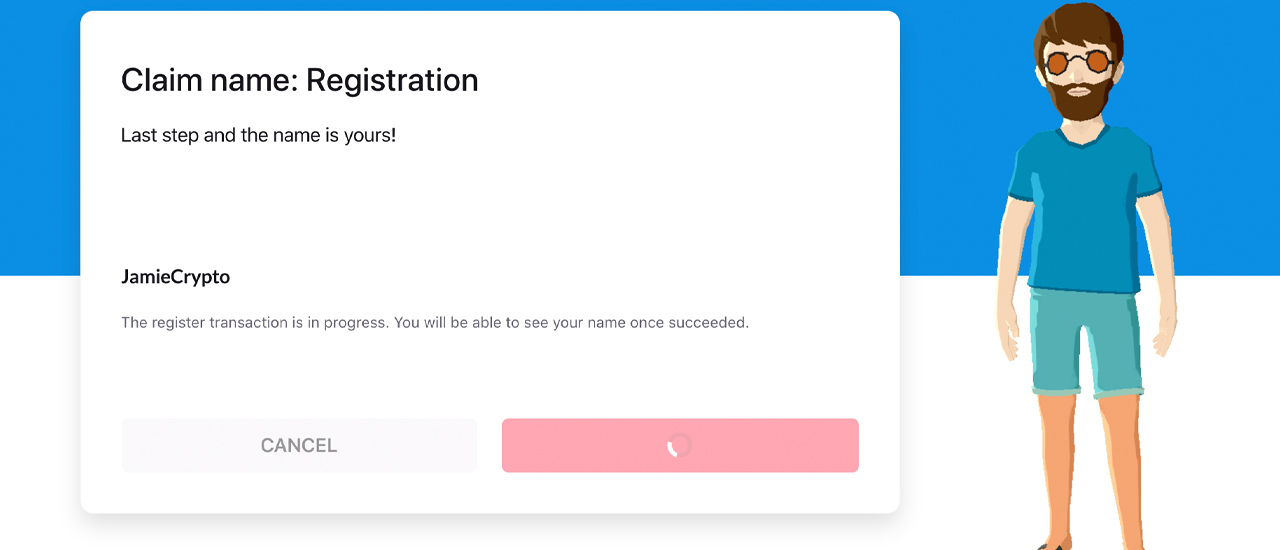
Registering my name. A custom name costs 100 MANA plus the gas fee.
After customizing your look, the program asks you if you want to grab your “Passport” to manage your digital identity. Meaning, anyone can pay 100 MANA (Decentraland’s ERC20 token) in order to obtain a custom name. Now after you customize your Avatar, you do not need to pay 100 MANA or register right away or at all.
You can also simply explore Decentraland as a guest. My sons decided that I should choose a name and I chose “Jamiecrypto” for my Decentraland Passport name. You can grab MANA by simply swapping ETH for Decentraland’s native currency using the Metamask wallet’s swapping feature.
The name “Jamiecrypto” was available, and I opened up a contract in order to obtain the name. However, because gas is so expensive right now I waited two solid days to finally get fed up, and pay $4.50 in gas to push the contract settlement. Ethereum’s fees are problematic right now and the issue will make Decentraland less fluid if the chain does not scale. Understanding this issue, I didn’t care too much and moved on, but this will definitely deter users from exploring Decentraland to its fullest extent.
After pressing “start exploring” at the Decentraland.org website it connected with my Metamask account and I entered the “Genesis Plaza” This area is like a introductory zone that has a number of cool buildings and a robot that gives you an explanation of Decentraland and what you can do.
After listening to the welcome robot, my sons told me to start roaming around and I did but I was leveraging a Macbook Pro with the built-in trackpad. Using a trackpad is slow and not the best accessory to use while you explore Decentraland.
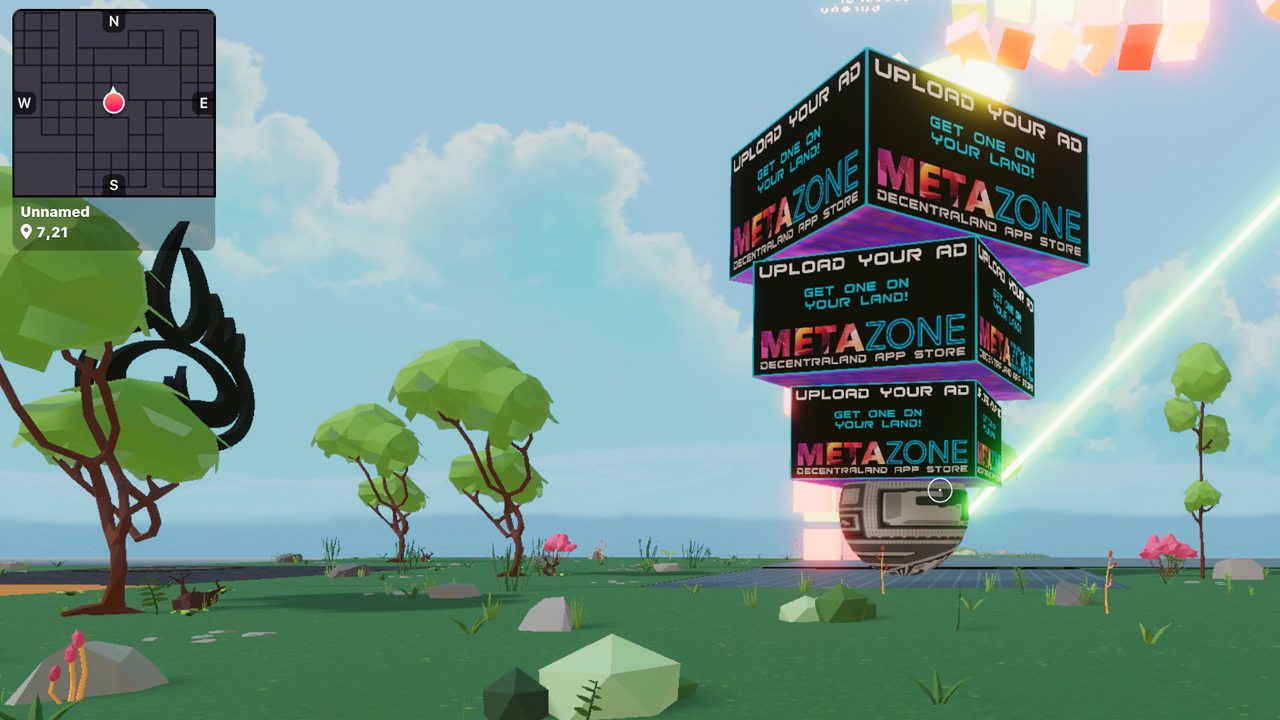
Metazone.io’s tower.
My son Joshua who is used to playing virtual world games like Roblox, told me we should hook up a mouse in order to move around. After hooking up a mouse, it was much easier to move around Decentraland and users can also press “/help” in order to learn the control mechanisms.
We all decided that I should roam around the “Genesis Plaza” and my sons wanted to explore the big brown building that resembles a shoe. This building is like a history museum of Decentraland and artifacts explain how it was built, how the governance system (DAO) works, and some of the hosted activities that take place in the virtual world.
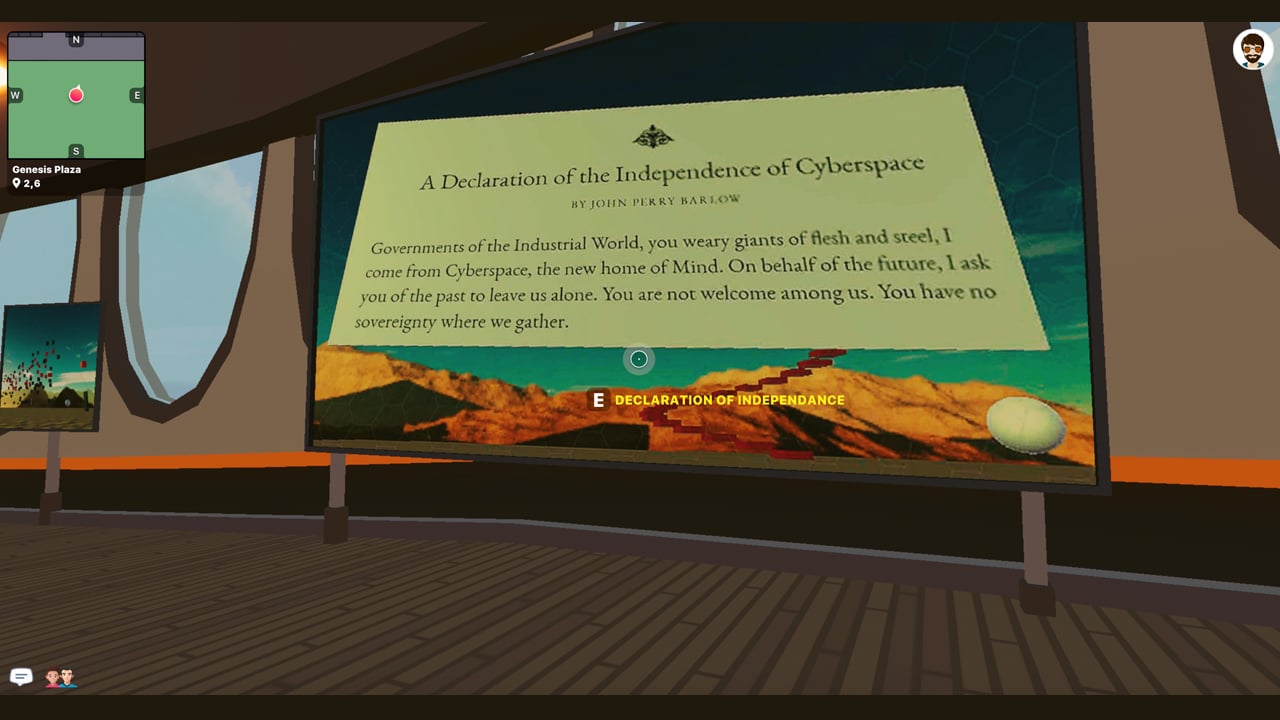
The three of us stopped for a minute to observe a poster of a John Perry Barlow’s “Declaration of the Independence of Cyberspace” and my oldest son Joshua read the paragraph which says:
Governments of the Industrial World, you weary giants of flesh and steel, I come from Cyberspace, the new home of Mind. On behalf of the future, I ask you of the past to leave us alone. You are not welcome among us. You have no sovereignty where we gather.
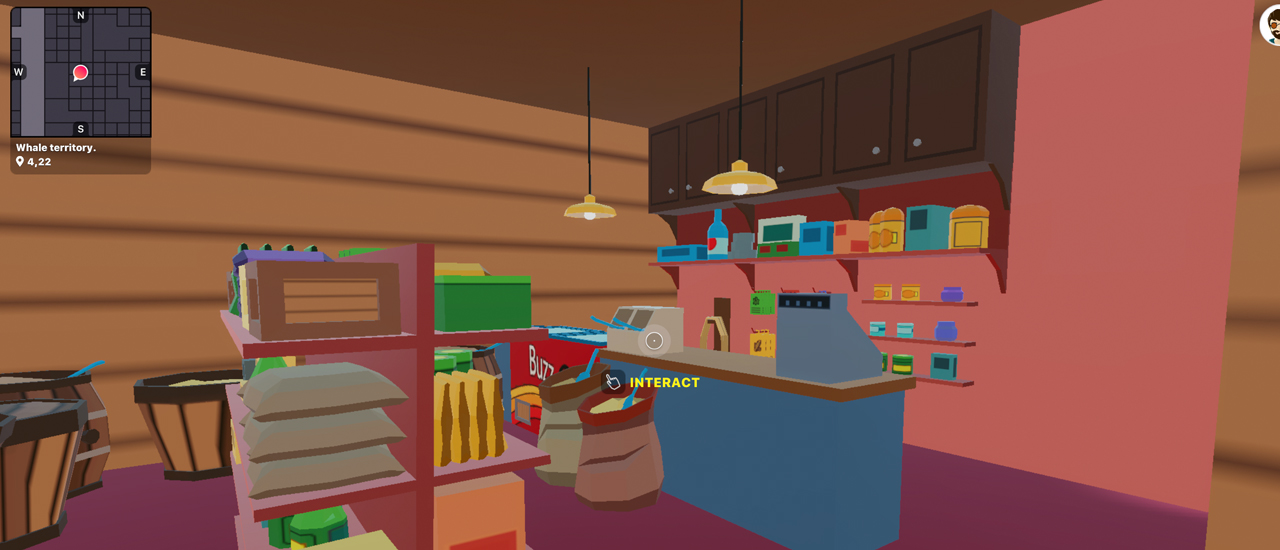
Decentraland visitors can interact with all kinds of virtual things in the virtual world like cash registers, rides, musical instruments, levers, and NFT items.
Decentraland has all kinds of artwork, buildings, and unique things, and the “Genesis Plaza” is one small aspect of this world. While exploring the plaza, we saw mountainous terrain that looked like a volcano and the “NFT Hallway,” which displays a number of non-fungible tokens (collectibles, artwork, wearables.)
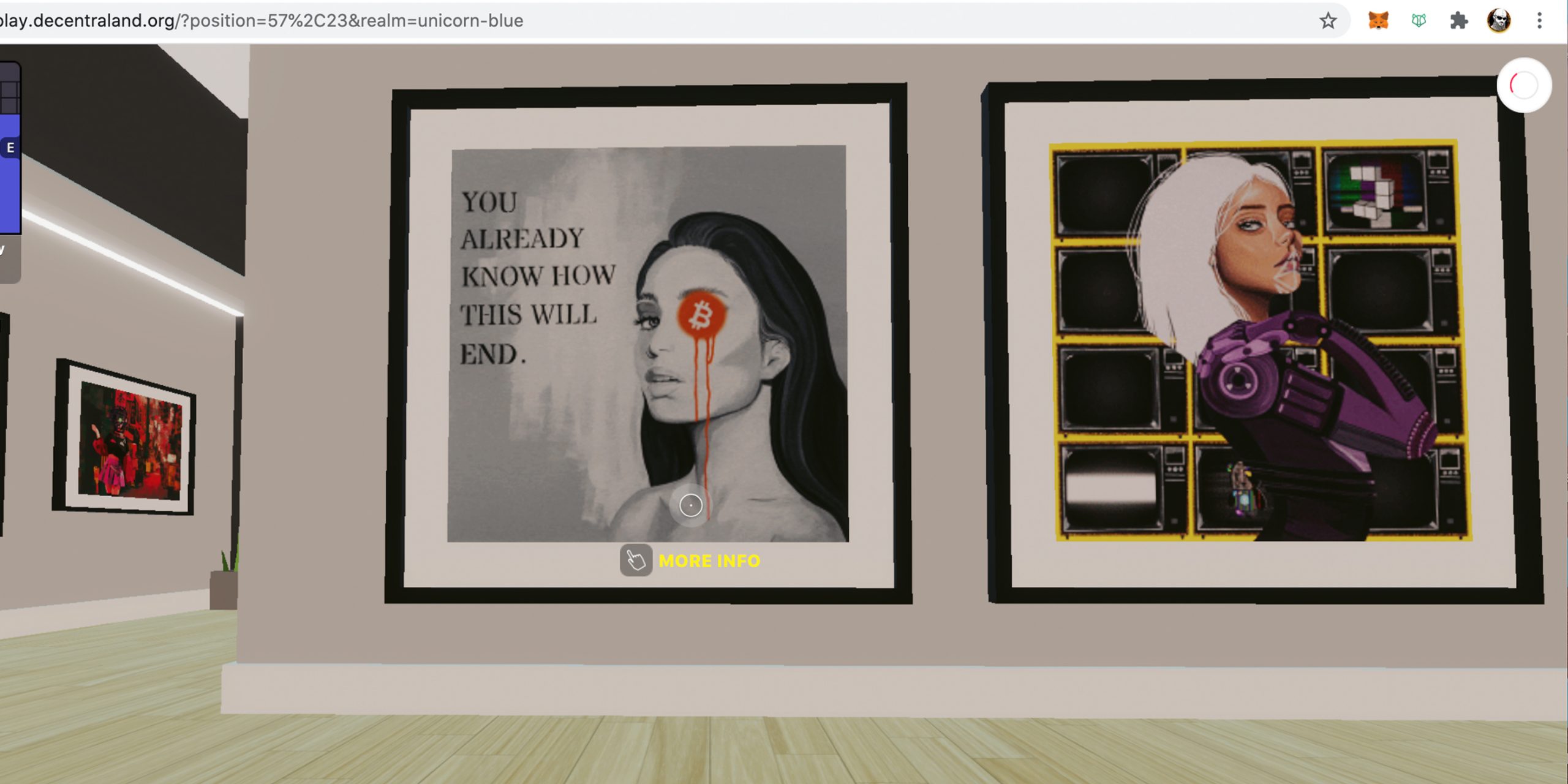
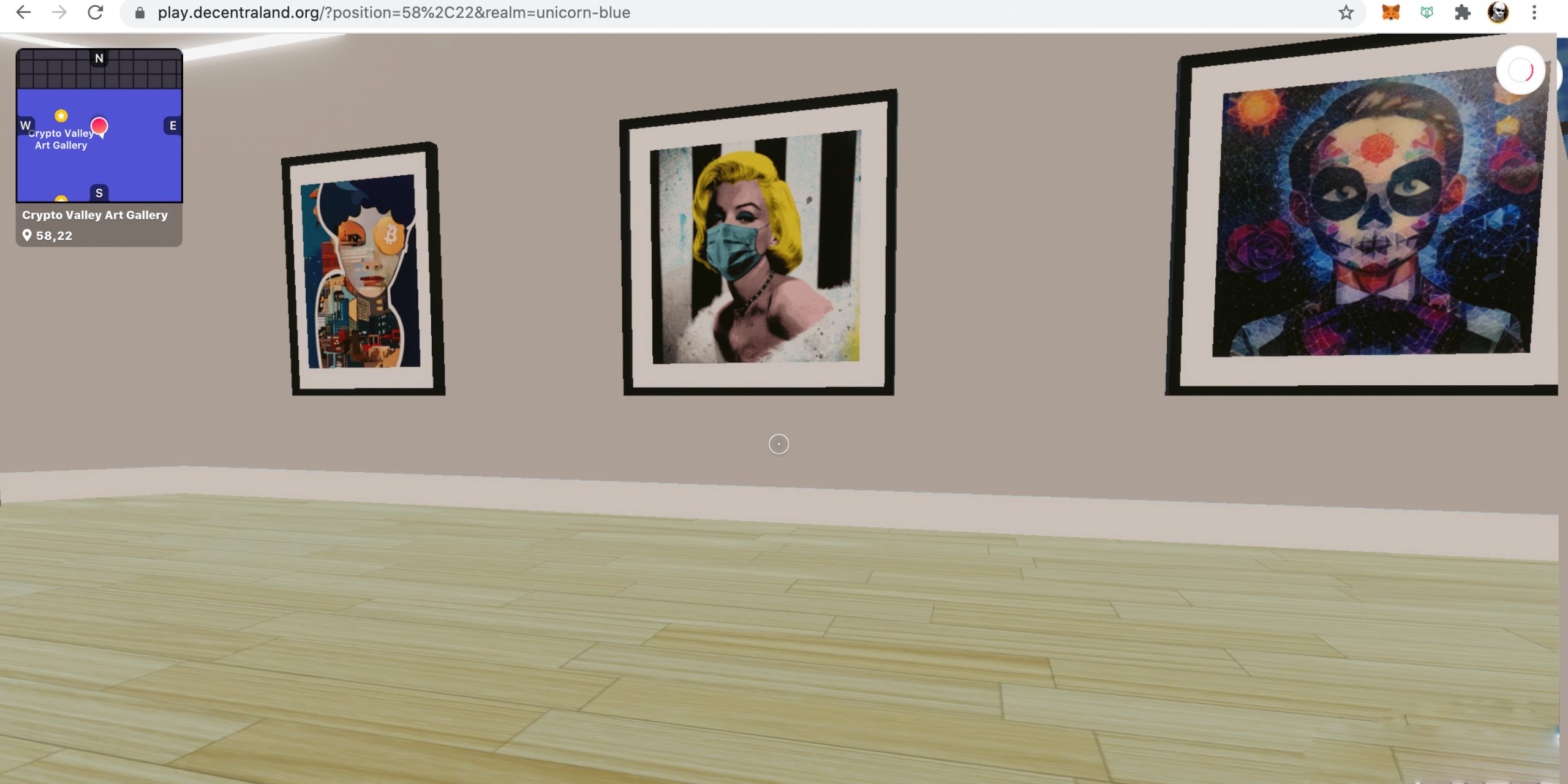
The Crypto Valley Art Museum.
Lots of the NFT shops are all over Decentraland and some NFTs are for show, while others can be purchased by using MANA. For instance, the shop from the crew at Digitible offers a number of NFTs and Ross Ulbricht collectibles as well. The funds spent on Digitable-crafted Ross wearables go directly to the Ulbricht family.
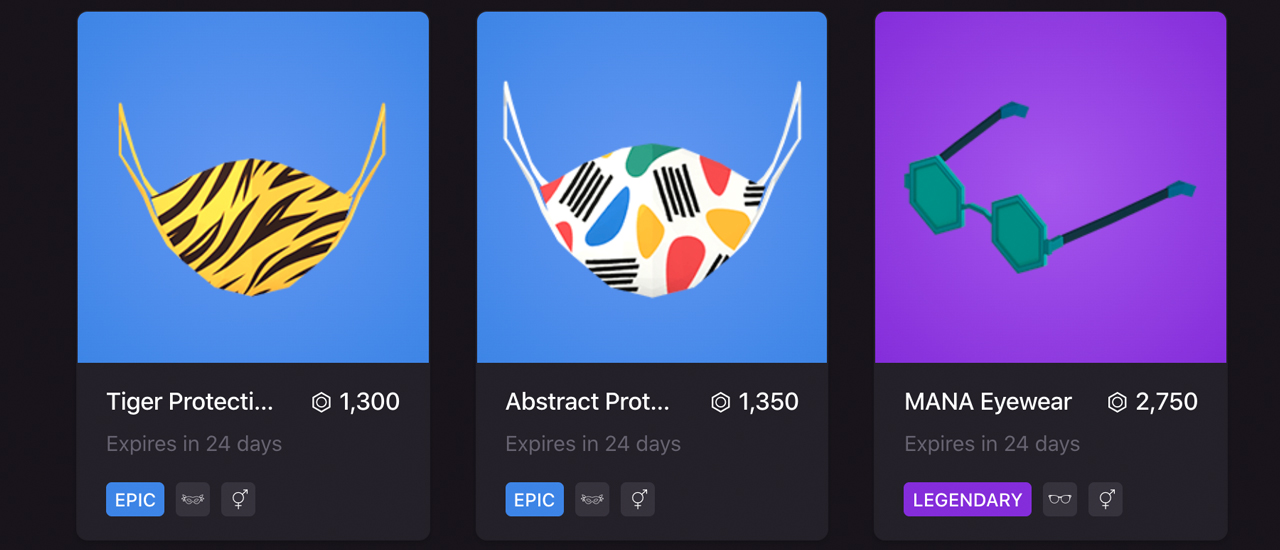
Of course, my kids wanted to buy everything in the virtual world of Decentraland. But during the entire exploration period, the only thing I spent MANA on was my custom name and the fee to settle the contract. Users can purchase wearables at the Decentraland Marketplace as well which sells hats, hoodies, shoes, shirts, and land parcels as well.
Wearables at the web portal market.decentraland.org.
I found that everything in the entire marketplace was extremely expensive and I just couldn’t fathom paying hundreds of dollars worth of MANA on a virtual hoodie. This is another criticism my kids and I had with Decentraland, and we all thought the game would be far more enjoyable if NFT goods were cheaper.
Decentraland is massive, and in order to warp to other places in the virtual world simply press “M” on the keyboard. This loads the map and my son’s and I visited places like the Scifi Plaza, the Asian Plaza, Metazone Tower, Battle Racers, Crypto Valley, and the Crypto Valley Art Museum, the Museum District, Pixelchain, Bartertown, Decentraland University, and many more areas.
The Crypto Valley Art Museum.
Over the course of two weeks, my sons and I still have not explored every crevice and plot in Decentraland. Joshua and Franklin enjoyed all the things that you could ride like the Ferris Wheel, race tracks, and the many obstacles throughout the metaverse.
My favorite place was the Crypto Valley Art Museum and the donut shop with two police cruisers sitting in front of the shop. My oldest son Joshua explores Decentraland on his own now too, as he downloaded Metamask on his own laptop and fires up the virtual world to explore.
My son Joshua playing with me as a guest user.
Yesterday, he added me as a friend by simply searching my name “Jamiecrypto” and we both explored Decentraland together on separate computers. During the last few months, Decentraland explorers hold small community events and gatherings. A few days ago, comic book illustrator Jose Delbo answered questions about his digital artwork in Decentraland during an exhibition.
Joshua is ten so he enjoyed the program a lot more than his seven-year-old brother Franklin. Overall, we all thought the experience is enjoyable and it’s very cool to see a virtual world built on top of the Ethereum network. My two sons also enjoyed the fact that they used a Metamask wallet for interaction and how the ETH chain powers the entire world.
The only issue I had with the entire Decentraland experience was the high ETH gas fees, which are a problem for every defi application right now and the expensive gear. I think that people marketing virtual wearables should come down on their prices, but I can see that happening if Decentraland gathers more users.
What do you think about the Decentraland experience? Let us know in the comments below.